AI Shopping: what it is, how to get in, how to measure it
AI Shopping is the product row an AI surface renders when a question carries buying intent: a different shelf from the text of the answer, built from different inputs, and won with different levers.
AI Shopping is the product row an AI surface renders when a question carries buying intent: a different shelf from the text of the answer, built from different inputs, and won with different levers. This article covers the three questions every brand asks in order: what a carousel actually is, how to get into one, and how to measure whether you did.
What AI Shopping is
When a question carries buying intent, the engine stops answering in prose alone: it renders a row of clickable products, each with an image, a title, a price, one or more merchants, and sometimes a rating. That row is a carousel.
The two halves of the answer come from different places:
- The text is written from the sources the engine reads and cites.
- The carousel is assembled mostly from structured product data: identifiers, price, availability, merchant.
The consequence is counterintuitive but constant: a brand can be named in every paragraph and absent from every shelf, or sit on every shelf and never be named. Treat them as two scoreboards, not one.
How to get into the carousels
What is known, and what is not
The machinery behind these carousels is opaque and moving. No surface documents how it selects or ranks products, and observed behavior changes month to month. We are at the very beginning of AI Shopping: treat every recommendation below as test-and-learn, not as a settled playbook.
The Merchant Center path
The products ChatGPT shows appear to come from Google Shopping, and therefore from Google Merchant Center, whose product feeds are already normalized and working. That has a direct consequence: to be visible in ChatGPT, be visible in Merchant Center first. The fight is won in the feed and in the structured data feeding it; copy is secondary.
Alexa for Shopping inverts this. There, the content of the page itself carries most of the weight.
The levers, by surface
GetMint measures two of these surfaces: ChatGPT and Alexa Shopping. The levers below also apply to Google AI Overview and AI Mode, which draw on the same product feeds as ChatGPT.
| Surface | What moves the ranking |
|---|---|
| ChatGPT, AI Overview, AI Mode | The product feed first: structured data, completeness, variant granularity, feed-to-page consistency. Then the product page: title and meta description, Hn structure, benefit bullets near the visual, a differentiator block under an H2, quantified claims, credibility copy (years of research, patents), ingredient or spec lists, instructions, FAQ, comparison table, visible reviews and rating, density of figures in the copy, visuals, structured data. |
| Alexa, Amazon | The listing: A+ content, reviews and rating, product fields, back-office keywords, questions and answers, plus the affiliate sites that feed the surface. |
Measuring your presence in AI Shopping
1. Pick prompts, and pick them bottom-funnel
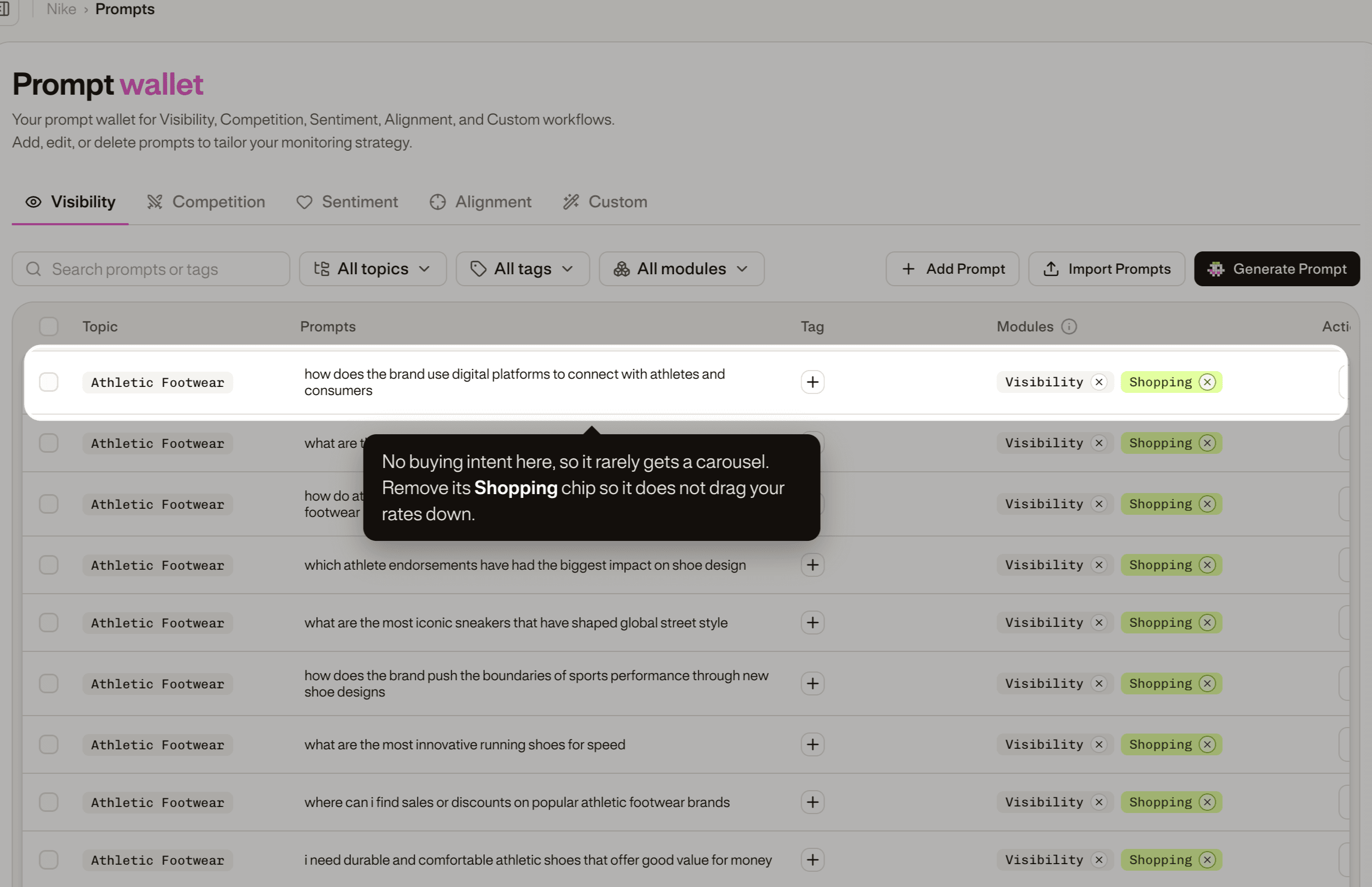
A carousel only fires on buying intent. Keep "best X for Y", comparisons, budget questions, "where to buy", and alternatives to a named product. Drop "how do I use", "why is my X doing Z", definitions and instructions: they return text, and they will drag your numbers down for a reason that has nothing to do with your products.
In GetMint, every visibility prompt of a topic feeds its Shopping page by default. To take a prompt with no buying intent out of Shopping, remove its Shopping chip in the Modules column of the Prompt Wallet.
2. Collect
Run the prompts and capture the product carousels rendered in the answers. In GetMint there is nothing to run: each topic has its own Shopping page, filled at every refresh. See Read the Shopping page.
3. Consolidate over 30 days
Average position is only usable with a floor under its uncertainty. The fewer runs you make, and the less you spread them over time, the wider the margin of error on every number below.
The KPIs to follow
- Carousel rate: the share of answers that return a carousel at all. It tells you whether the engine considers the subject commercial, before your brand is even in question.
- Brand products visibility: the share of carousels that list at least one of your products. It counts presence, not slot.
- Share of shelf: every brand ranked by the share of carousels it appears in. It measures presence, not the number of cards.
- Average position: the slot held when the product is present. It only reads on a sufficient volume of executions, and it is the one that triggers the decision.
- Top products: the references that surface, yours and everyone else's, consolidated at product level. It shows which reference actually carries the range.
- Who captures your demand: which merchants sell the products inside the carousels. It tells you who owns the shelf in your place.
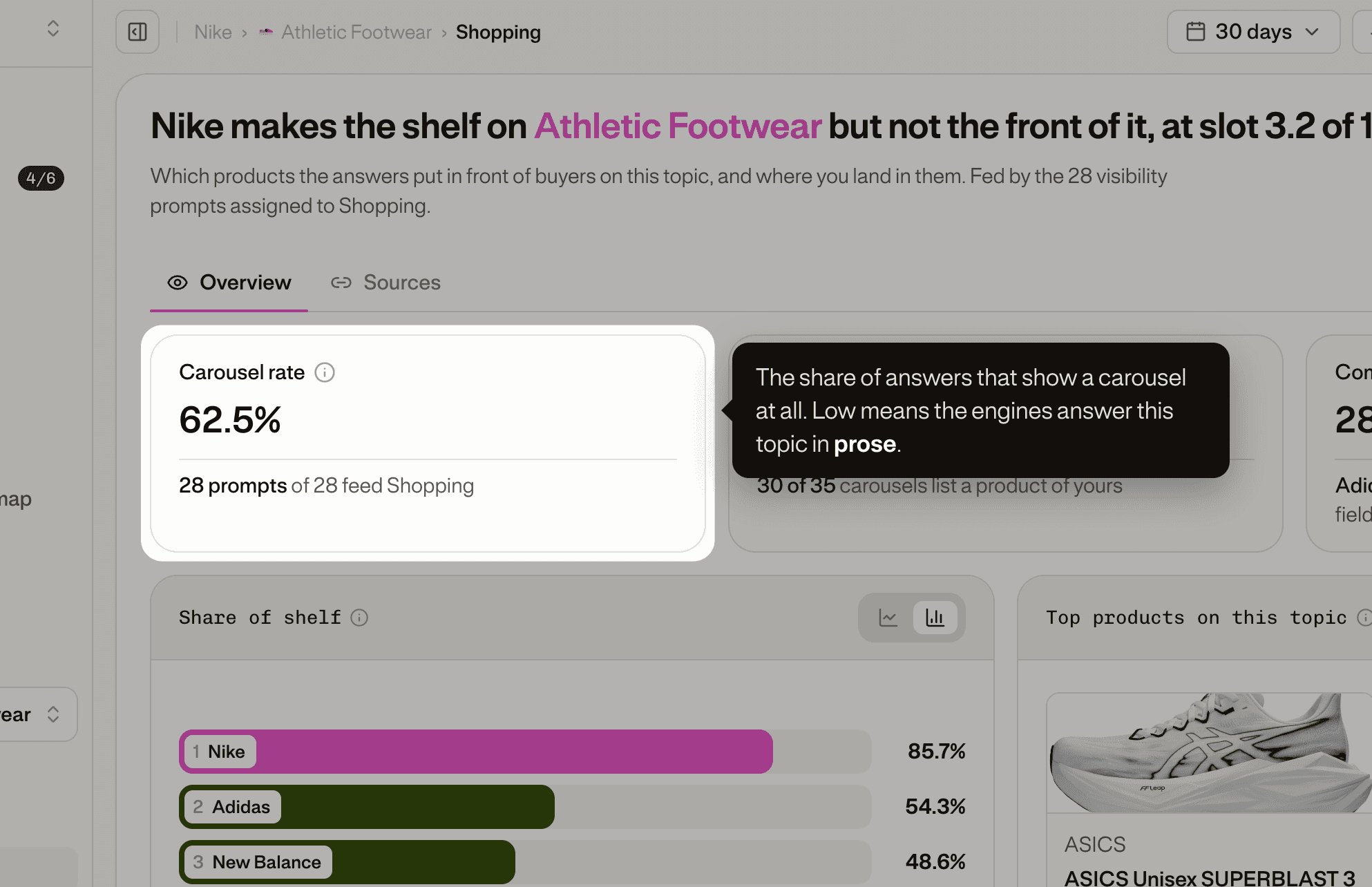
Reading a position, and deciding
Two readings coexist, at two levels:
- The topic verdict, at the top of the Shopping page, judges your brand across all its products. Under half the carousels, you miss the shelf; otherwise an average slot of 2 or better means you lead the shelf.
- The product decision, below, is taken prompt by prompt: is this product in the carousel, and at what slot? Click a product on the Shopping page to see every appearance, with its prompt, model and slot.
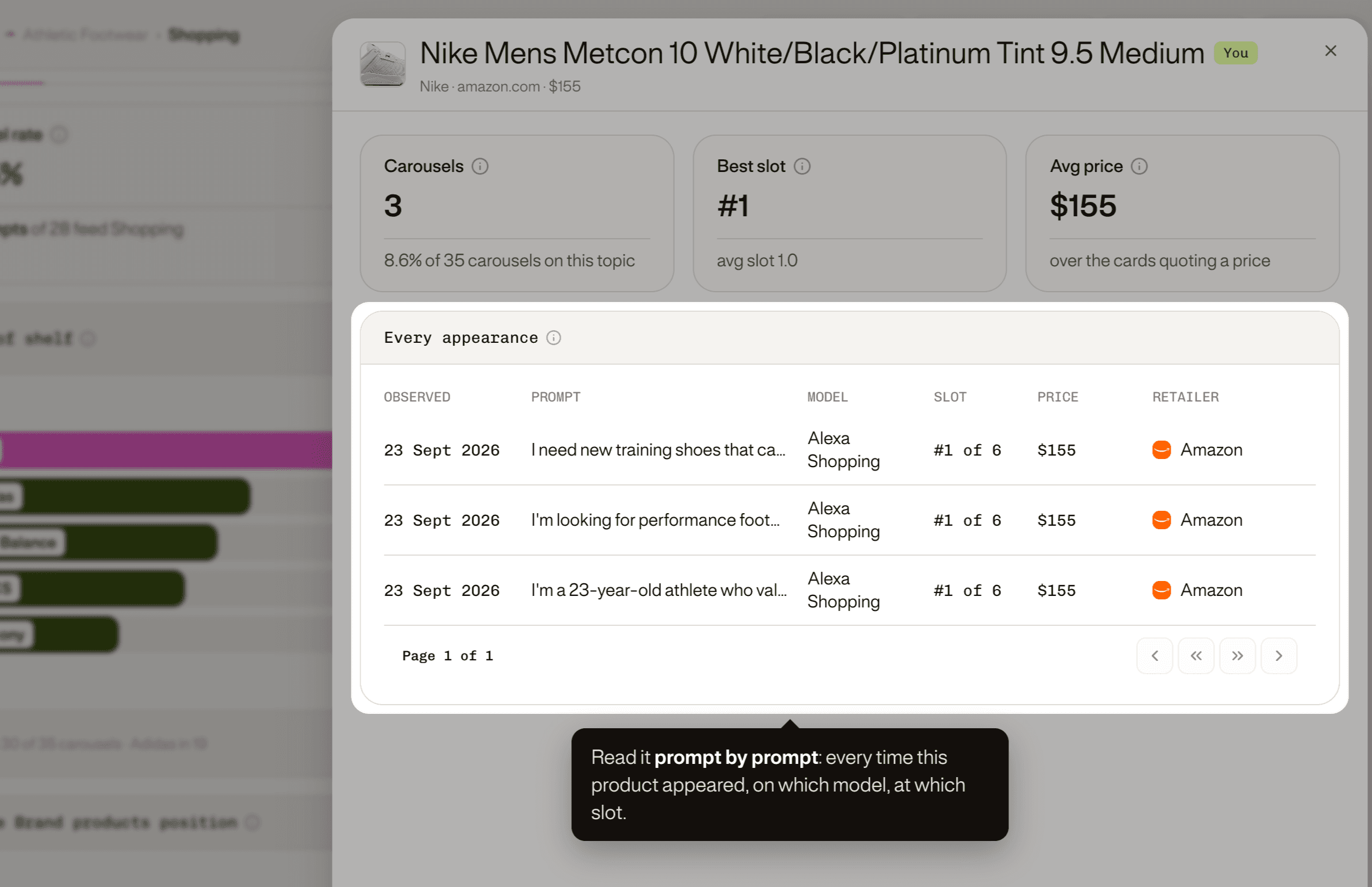
A brand can lead the shelf on the topic while one of its products sits at slot 2 on a given prompt: the verdict sums up the brand, the table below acts on the product.
| Position of the product on a prompt | What it says | What you do |
|---|---|---|
| 1 | Present, and dominating the shelf | Leave it alone: the risk is hurting a ranking you already hold |
| 2 to 4 | Present and visible, but the slot is won at the margin | Optimize, starting with the lever of the surface concerned |
| None | Absent from the carousel, no visibility | Optimize the page, then consider a paid campaign on the subject |
Key takeaways
- 01A carousel is built from structured product data; the text of the answer is built from sources. A brand can win one and lose the other.
- 02No carousel fires without buying intent: never score a brand on a prompt that returns text only.
- 03The mechanics are undocumented and moving: treat every lever as test-and-learn.
- 04ChatGPT, AI Overview and AI Mode are won in the product feed first, the product page second. Alexa and Amazon are won on the listing. GetMint measures ChatGPT and Alexa Shopping.
- 05Pick bottom-funnel prompts, remove the Shopping chip from the others, and consolidate over 30 days before reading an average position.
- 06Six KPIs: Carousel rate, Brand products visibility, Share of shelf, average position, top products, who captures your demand.
- 07The topic verdict judges the brand; the product decision is taken prompt by prompt. Position 1: don't touch it. 2 to 4: optimize at the margin. Absent: fix the page, then consider paid.